The position links along the way open real positions from the Olympics and the Japan Curling Championships in CurlFlux. From the position that opens, you can throw stones yourself and try things out.
| What you want to know | Where to read |
|---|---|
| I just want to be able to follow a game | 1. Start here: curling in three minutes |
| Things you wondered about while watching (What are they shouting? Why did they shake hands and stop early?) | 1-8. Things you notice on TV |
| The finer points of the rules | 2. The rules in detail |
| What's a "double" or a "freeze"? What does "7!" mean? | 3. Types of shot |
| Why teams choose the plays they do | 4. Strategy and 5. Tactics |
| Terms you don't know | Glossary |
The rules here follow World Curling's "The Rules of Curling and Rules of Competition" of 1 September 2026, and centre on the four-player game. The number of ends, thinking time, the last stone draw, conceding, and the details of mixed doubles and wheelchair curling can differ by event and discipline; at a real game, that event's conditions and the latest rules take precedence.
1. Start here: curling in three minutes
1-1. What the game is about
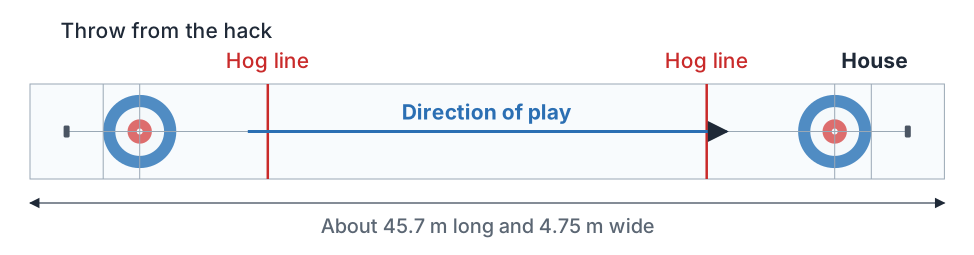
Teams slide stones along the ice toward a circle (the house) about 40 m away, trying to get closer to its centre than the other team (the sheet itself is about 45.7 m long).
At the end of an end, each of your stones that lies closer to the centre than every one of the opponent's stones scores a point. This is repeated ten times (10 ends), and the total score decides the winner.
1-2. How scoring works
When an end is over, only the team with the stone closest to the centre of the house (the button) scores.
They score one point for each of their stones that is closer than the opponent's closest stone.
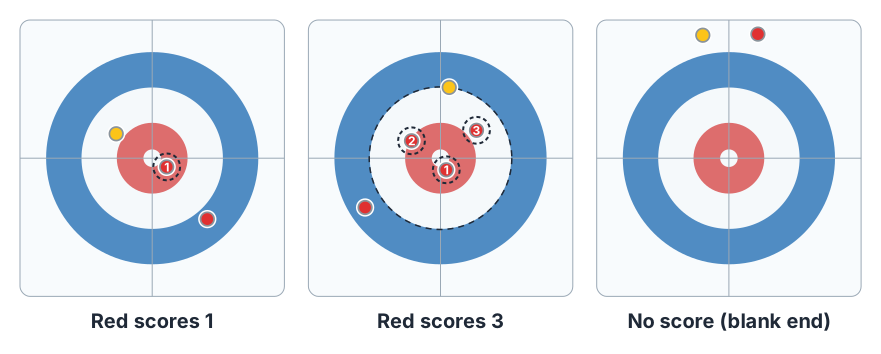
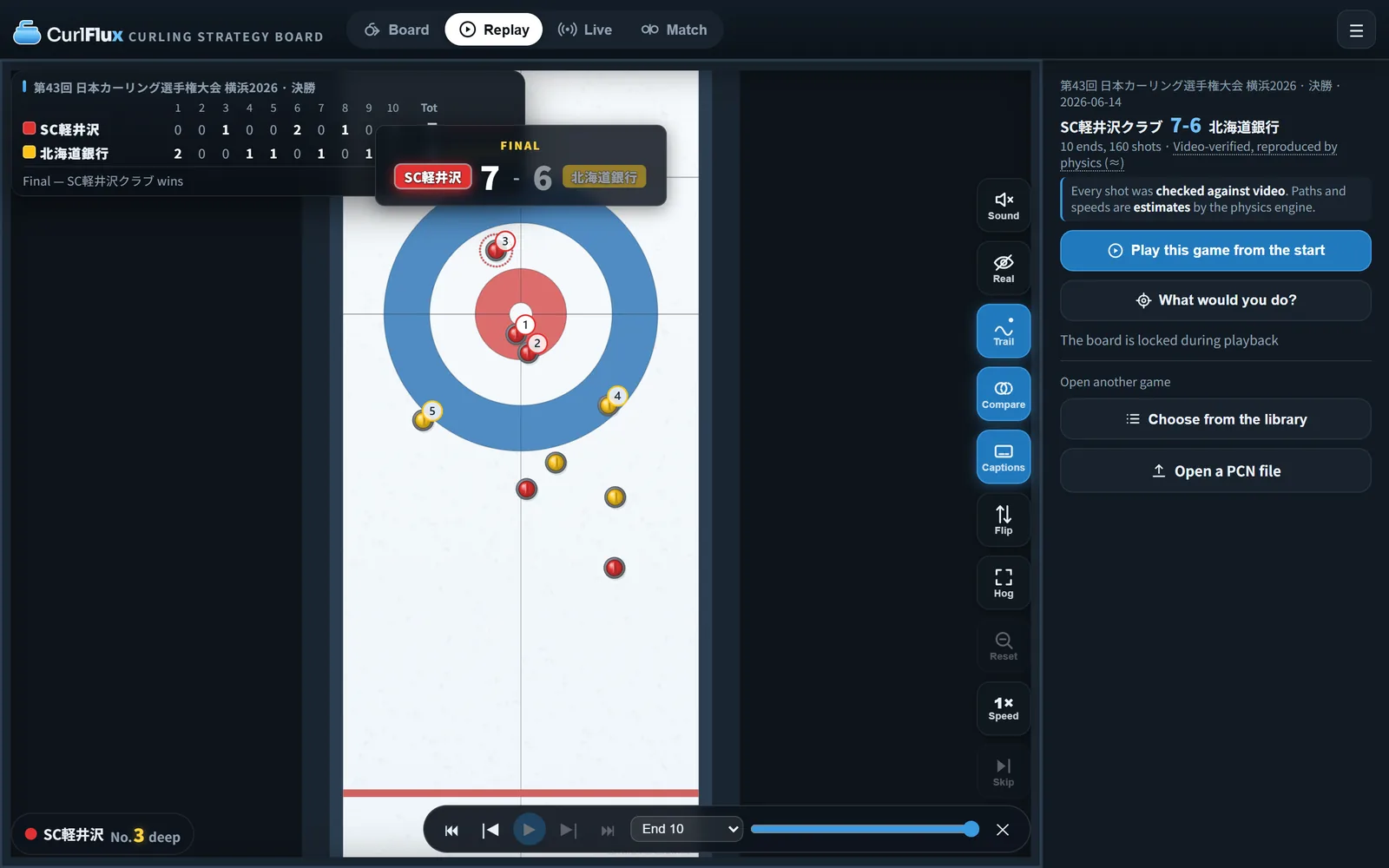
2026 Japan Curling Championships, women's final: the last stone of the last end. SC Karuizawa Club got three stones inside and scored 3 to come from behind and win the title
Before the shotAfter the shot
- Both teams never score in the same end
- A stone that isn't touching the house at all doesn't count
- When it's too close to tell by eye, the distance is measured with a special device
In CurlFlux, stones in the house are numbered from closest to farthest, and scoring stones get a white circle. You can use it as it is to practise counting.
1-3. How an end goes
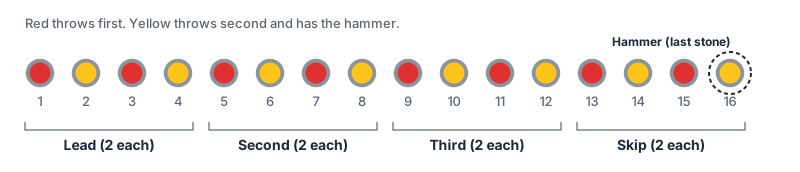
- Four players per team. Each player throws two stones, so a team throws eight. Some events also allow one alternate to be registered
- The two teams take turns, one stone at a time. 16 stones make one end
- Most teams throw in the order lead → second → third → skip. The skip, who directs play, throws the last two stones
(Teams declare their throwing order before the game. On some teams the skip throws third.)
1-4. The hammer (last stone)
The last stone of an end is called the hammer. The team throwing second sees all the opponent's stones before throwing last, so it has the advantage.
- The team that scores throws first in the next end (the hammer passes to the opponent)
- If neither team scores (a blank end), the hammer stays where it is
- Who throws first in the first end is either agreed in advance or decided by the pre-game last stone draw (LSD) or a coin toss. In an LSD, each team delivers two stones to the tee (the centre of the house), thrown by two different players, and the team with the smaller total distance chooses whether to throw first or second (usually they choose second)
When commentators say a team "has the hammer" or "has last stone", this is what they mean.
1-5. Why do they sweep?
Sweeping the ice in front of the stone with a brush reduces friction, so the stone travels farther and curls less.
It's the main way to adjust distance and curl after the stone has been thrown.
Most of the shouting you hear is about sweeping. The common calls are below (the exact words vary a little from team to team).
| Call | Meaning |
|---|---|
| "Yes", "Yah", "Yup", "Go" | Sweep |
| "Hard", "Hurry", "Hurry hard" | Sweep hard |
| "Clean" | Sweep lightly, mainly to keep the path clean |
| "Whoa" | Stop sweeping |
| "Off" | Take the brooms off the ice; don't sweep at all |
The skip in the house watches the line (the curl), while the sweepers running alongside the stone feel the weight (how far it will go), and they shout to each other. The numbers the sweepers shout say how far they expect the stone to go (the zones in 3-1).
1-6. Why do stones curl?
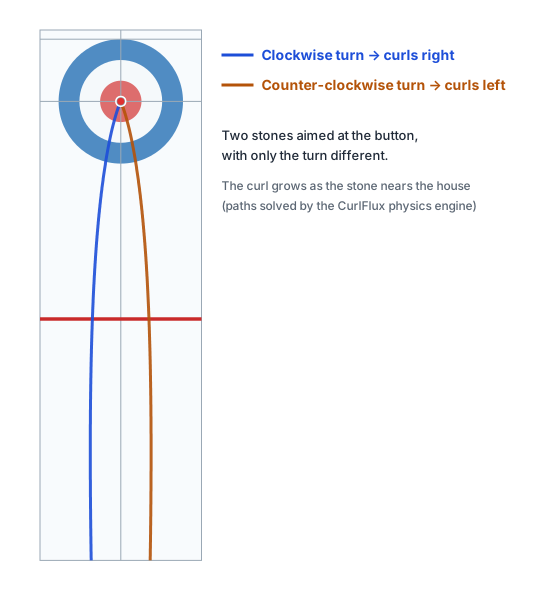
When throwing, the player gives the stone a slow spin (4 to 5 rotations per throw is typical in today's game; top players use 5 to 7). The stone bends in the direction of its spin (the curl).
It doesn't curl evenly: while it is fast it hardly bends, and most of the curl comes as it slows down in front of the house.
Because it curls, it can come around behind a stone in front (a guard).
1-7. Tips for watching
- Watch which team has the hammer (the TV score display marks it)
- Watch the ends left and the score difference. The basic aim: with the hammer, score 2 or more; without it, hold the opponent to 1 or take a point yourself (a steal)
- In the last few stones, keep counting whose stone is closest in the house right now
1-8. Things you notice on TV
- What are they shouting?
Mostly sweeping calls (1-5). "Yup" means sweep, "Whoa" means stop - What are the numbers the sweepers shout?
Zone numbers the team has agreed on, telling how far the stone is likely to go. In the widely used "Ferbey system", "7" is around the button (3-1) - Why does the skip hold a broom down in the house?
It's the target. The thrower aims at that broom. The skip signals the direction of spin with a hand or arm - Why is only one of the four players in the house?
That player gives the instructions. Usually it's the skip; when it's the skip's turn to throw, the third (vice) takes over - Why does one foot slide so easily?
The two soles are different. The foot a player slides on when throwing has a slippery sole (a slider); the other foot has a grippy one - Why is the ice surface bumpy?
The ice has tiny bumps called pebble, made by sprinkling water on the ice and letting it freeze. They reduce friction between the ice and the stone so it slides more easily - Do the blue and red in the house mean anything?
No. The rules only set the sizes of the circles, not their colors. The score depends only on distance from the centre - What's the clock in the corner of the screen?
Thinking time. In major events, the time teams can spend planning is limited (2-8) - When can a team take a timeout, and what is happening?
A player on the ice signals a "T" while their own clock is running. Each team gets one 60-second timeout per game (and one more in each extra end).
One coach from the bench (plus a translator if needed) comes to the side of the ice to discuss that one shot. The time it takes them to walk there is added on top of the 60 seconds, which is why it looks longer than a minute on screen - What are they timing with a stopwatch?
How many seconds the stone takes from the near hog line to the far hog line (the hog-to-hog time). The ice changes through the day, so a measured time is the team's shared yardstick for "how far this weight runs on today's ice".
Those seconds are also how takeout weight is called (3-1). Some teams time a "split" at the delivery end instead - What are "Plan A" and "Plan B"?
Not a rule term, but how teams talk about their options. Before the throw they agree on the best outcome (Plan A) and on the next best one if the stone curls more, or runs farther, than expected (Plan B).
While the stone is travelling, the call to sweep or not is what switches between them, and making that switch quickly is often what turns a near miss into a good shot - Is a stone touching a line safe, or is it out?
It depends on the line. A stone must completely cross the far hog line to count; a stone is out only when it completely crosses the back line (still touching it is in play); and a stone is out the moment it touches a sideline (2-3) - Why are they measuring between stones with a device?
It's for when you can't tell by eye which stone is closer to the centre. The measurement decides the score - Why did the game end early with handshakes?
One team "conceded": it admitted defeat to end the game (2-7) - Why was Japan's 2018 team famous for its snack break?
Halfway through a 10-end game (after the fifth end) there is a 5-minute break, called half-time. At PyeongChang 2018, Japan's team (Loco Solare) ate fruit and sweets during it, and in Japan the break became known as "mogumogu time" ("munch-munch time").
"Sodane" ("yeah, right"), which the players often said to each other on the ice, was named Japan's 2018 Buzzword of the Year
2. The rules in detail
These rules follow World Curling's rulebook, "The Rules of Curling".
2-1. The sheet and the house
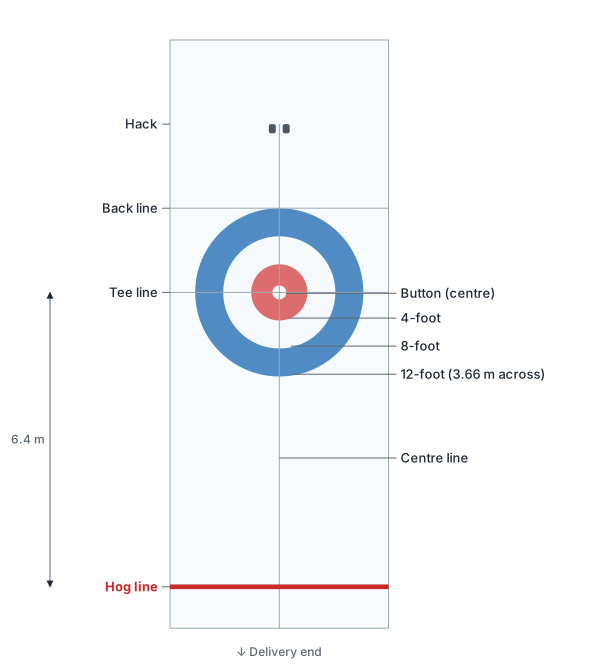
| Part | Size and meaning |
|---|---|
| Sheet | One strip of ice. About 45.7 m long and up to 4.75 m wide (in existing facilities it can be as short as 44.5 m and as narrow as 4.42 m) |
| House | A circle 3.66 m (12 feet) across. Inside it are the 8-foot (2.44 m) and 4-foot (1.22 m) circles and, at the centre, the button (radius at least 15.2 cm) |
| Tee line | The line across the centre of the house |
| Centre line | The line running lengthwise down the middle of the sheet |
| Hog line | A thick line 6.4 m out from the tee line. There is one at each end |
| Back line | The line touching the back edge of the house |
| Hack | The foothold a player pushes off from when throwing |
The two hog lines are about 21.9 m apart (inside edges), and the two tee lines about 34.7 m apart.
2-2. Stones
A stone is made of granite and weighs between 17.24 and 19.96 kg by rule (20 kg at most), with a circumference of at most 91.4 cm and a height of at least 11.4 cm. It has a handle on top, and the two teams are told apart by color (for example, red and yellow).
2-3. Delivery rules, and the lines that put a stone out of play
The stone must be released before it reaches the hog line at the throwing end. A stone that breaks this rule is removed (some events judge this with an electronic sensor in the handle).
If the stone has not yet reached the tee line at the throwing end, it can be returned to the player and delivered again — a separate rule from where the stone has to be released.
Each line puts a stone out of play on a different condition. This is one of the harder things to follow on TV.
| Line | Condition | How to remember |
|---|---|---|
| Far hog line | A stone that has not completely crossed it is removed (unless it hit another stone) | It has to cross to count |
| Back line | A stone that completely crosses it is removed (a stone still touching the line is in play) | Fully past means gone |
| Sideline (the divider to the next sheet) | A stone that touches it is removed at once | Touch it and it's gone |
2-4. Free guard zone (five-rock rule)
This rule stops guards placed early in an end from being knocked out straight away.
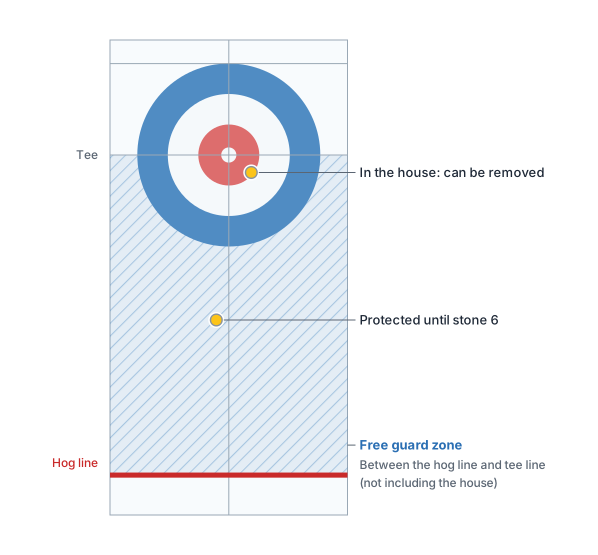
- Free guard zone: the area between the far hog line and the tee line, not counting the house
- Up to the fifth stone of the end (both teams together, so until the sixth stone is thrown), you may not remove an opponent's stone in the free guard zone from play. You may move it, as long as it stays in play
- If you break the rule, the thrown stone is removed and the non-offending team puts the moved stones back where they were
A centre guard: Beijing 2022 women's semifinal, 2nd end, the first stone of the end, thrown by Japan's Yurika Yoshida (Japan threw first). A guard placed in front of the house, on the centre line Before the shotAfter the shot
It began in 1993 as "up to the fourth stone" (the four-rock rule) and was extended to "up to the fifth stone" in 2018. The aim is to leave more room for attacking play, so that games stay winnable even when one team falls behind.
2-5. No-tick shot (2022 onwards)
Up to the fifth stone, you also may not move an opponent's stone that is in the free guard zone and touching the centre line to a position off the centre line, or out of the free guard zone (a ban on the sideways "tick shot").
- If the rule is broken, the team whose stone was moved chooses: remove the thrown stone and put the moved stones back, or leave everything as it is
- If the stone is knocked out of play, it's treated the same as a free guard zone violation (2-4)
- It doesn't apply to wheelchair curling or mixed doubles
The rule shuts down a standard early-end pattern: the team throwing first puts a guard in the centre, and the team with the hammer ticks it aside to escape.
The Beijing 2022 example in 2-4 is a guard touching the centre line. Under today's rules, it couldn't be moved aside during the first five stones (at Beijing 2022, the no-tick rule didn't exist yet).
2-6. Sweeping rules
- In front of the tee line, several players from the throwing team may sweep their own stone at the same time
- A stationary stone has to be set in motion before it can be swept
- An opponent's stone may be swept only behind the tee line, once it has reached the tee line
- Behind the tee line, only one player from each team may sweep at a time. For the team that isn't throwing, only the skip or vice may sweep
- How you sweep is regulated too: the brush head must not be lifted in front of a moving stone, no debris may be left in its path, and each stroke must finish to one side of the stone. In officiated play the umpires watch for this; a violation brings a warning, and after that the non-offending team chooses between leaving the stones where they are and removing the thrown stone and putting the others back
If a moving stone is touched (also called a "burned stone"), what happens depends on where it was touched and which team touched it.
- Touched by its own team before the far hog line → the stone is removed at once
- Touched by its own team after it crosses the far hog line → once the stones stop, the non-offending team chooses: remove the touched stone and put the others back, leave everything as it is, or place the stones where they would have stopped if it hadn't been touched
- Touched by the opposing team → the team whose stone was touched places it where it would have stopped if it hadn't been touched (if a thrown stone is touched before the hog line, it's thrown again)
2-7. How a game ends
- The game is decided on total score after the scheduled number of ends (10 for four-player games)
- If the score is tied, an extra end is played. Whoever scores wins
- PyeongChang 2018 women's semifinal, the last stone of the extra end. Korea made it to win 8-7 Before the shotAfter the shot
- Conceding: a team that judges a comeback unlikely can admit defeat and end the game without waiting for the scheduled ends. A handshake is the signal
- In 10-end games at world events, a team can't concede until 6 ends are complete in the round robin, or 8 ends in the playoffs
- Beijing 2022 women's final: Japan conceded after the 9th end Open this position
2-8. Thinking time and timeouts
In major events, each team has a fixed allowance of time for planning (thinking time). A team that uses it all up loses.
World Curling's rules of competition set these:
| Format | Thinking time |
|---|---|
| Four-player, 10 ends | 38 minutes per team |
| Four-player, 8 ends | 30 minutes per team |
| Wheelchair | 38 minutes per team |
| Wheelchair mixed doubles | 26 minutes per team |
| Mixed doubles | 22 minutes per team |
- In an extra end the clocks are reset and each team gets more time (4 minutes 30 seconds in 10- and 8-end games)
- One 60-second timeout per game (plus one more for each extra end)
- After the end that marks the halfway point there is a break, normally 5 minutes (7 in wheelchair mixed doubles). Its length is set by each event
A 10-end four-player game often takes around two and a half to three hours, but this varies a lot with how the game goes.
2-9. Mixed doubles
Two players per team, one man and one woman. Differences from four-player curling:
- 8 ends. Thinking time is 22 minutes per team
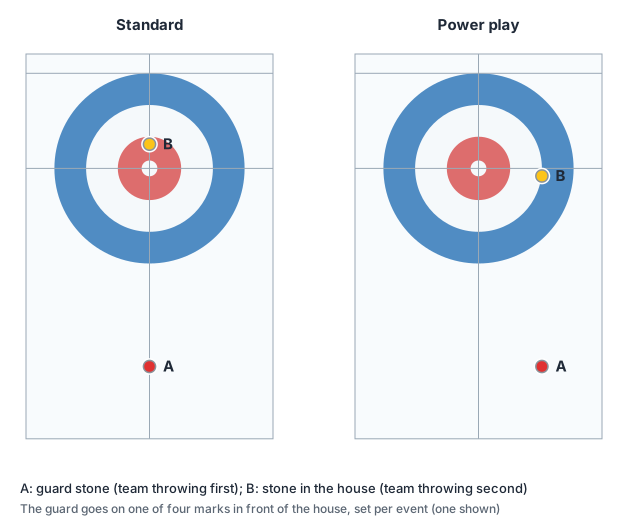
- Each team throws five stones per end. Before each end starts, each team has one pre-placed stone set down. There are two spots: one on the centre line in front of the house (the guard; its exact spot is chosen per event from four marks, 1.37, 1.98, 2.59 and 3.20 m out from the front edge of the house), and one in the house (the stone's back edge aligned with the back edge of the 4-foot circle)
- The player who throws the first stone also throws the last (fifth) stone, and the other player throws stones 2 to 4 (which player throws first can change from end to end)
- Before the fourth stone is thrown (that is, through the third stone), no stone may be removed from play, including the pre-placed stones (the mixed doubles version of the free guard zone)
- Power play: once per game, when it's a team's turn to decide where the pre-placed stones go, it can put the stone in the house and the guard off to the same side instead of in the centre. It can't be used in an extra end
2-10. Wheelchair curling
Players deliver the stone from a stationary wheelchair, using their hand or a delivery stick (a long pole). There is no sweeping. Games are 8 ends.
At World Curling events, the four players on the ice all deliver stones, and the team must include both men and women at all times.
3. Types of shot
Shots have names. World Curling's official records classify every shot using these categories.
The success rates come from counting about 480,000 four-player shots in the official records. World Curling scores every shot from 0 to 4, and we show the average with 4 = 100% (the shot categories are the official ones; the counting is ours).
| Shot | What it does | Success rate |
|---|---|---|
| Draw | Stops in the house | 79% |
| Guard | Stops in front of the house to protect stones behind it | 86% |
| Front | Stops just in front of the house | 91% |
| Raise | Hits a stone in front and pushes it farther in | 69% |
| Wick | Glances off the edge of another stone to change direction | 69% |
| Freeze | Stops tight against an opponent's stone (hard to knock out) | 66% |
| Takeout | Knocks an opponent's stone out | 82% |
| Hit and roll | Knocks a stone out, then rolls to a good spot | 77% |
| Clearing | Clears away guards and other stones with force (peel) | 90% |
| Double takeout | Knocks two stones out with one throw | 71% |
| Promotion takeout | Pushes a stone in front into a stone behind to knock it out (runback) | 63% |
Placement shots (front, guard) have high success rates, and shots that go via another stone (promotion, freeze, raise, double) have low ones. They are thought to be harder because the stone has to be played precisely off another stone.
Real examples (open each one to compare the position before and after the shot)
- Double takeout: Beijing 2022 women's semifinal, Satsuki Fujisawa's double for 4 points Before the shotAfter the shot
- Double takeout (made, but still giving up points): PyeongChang 2018 women's semifinal, Fujisawa's double. Korea still scored 2 Before the shotAfter the shot
- Hit and roll: Milano Cortina 2026, Japan vs USA. Tabitha Peterson's hit and roll gave the USA a steal of 1 Before the shotAfter the shot
- Draw: 2025 Japan Olympic Trials, game 3, Sayaka Yoshimura's last stone. It ends 6-5 and decides the Olympic team Before the shotAfter the shot
- Draw (steal): PyeongChang 2018 women's bronze medal game, 9th end. Fujisawa's draw steals 1 Before the shotAfter the shot
- Promotion takeout: Milano Cortina 2026, Denmark vs Japan. Madeleine Dupont's promotion for 3 points Before the shotAfter the shot
- Raise: PyeongChang 2018 women's bronze medal game, 7th end, Yumi Suzuki Before the shotAfter the shot
- Wick: PyeongChang 2018 women's bronze medal game, 8th end, Chinami Yoshida Before the shotAfter the shot
- Freeze: Beijing 2022 women's final, 6th end, Satsuki Fujisawa. She freezes onto a Great Britain stone and takes back No. 1 for Japan Before the shotAfter the shot (the official record classes it as a draw)
3-1. Weight: zones for draws, seconds for takeouts
How weight (how hard to throw) is called depends on the shot. Neither method is a rule; both are just what teams use.
For draws (shots meant to stop), where the stone will stop is often called as a "zone" from 1 to 10. This is known as the "Ferbey system", and many teams use it.
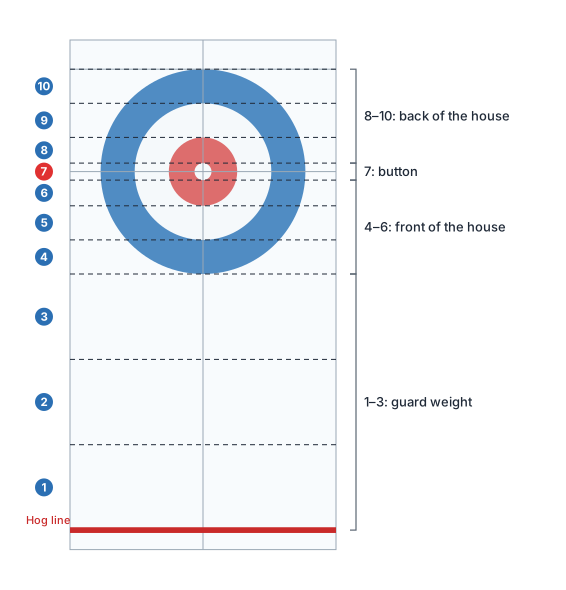
| Zone | Where the stone stops |
|---|---|
| 1–3 | From the hog line to just in front of the house (guard depth; 1 is nearest the hog line) |
| 4 | Just inside the house (front of the 12-foot) |
| 5 | Front of the 8-foot |
| 6 | Front of the 4-foot |
| 7 | The button (centre) |
| 8 | Back of the 4-foot |
| 9 | Back of the 8-foot |
| 10 | Back of the 12-foot (in front of the back line) |
Right after the throw, the sweepers shout where they expect the stone to finish ("5!", "7!") and decide with the skip whether to sweep. Some teams divide the zones differently.
Some teams borrow the marks used for the mixed doubles positioned stones (the four points on the centre line in front of the house; see 2-9) and call a spot by them, saying things like "third dot".
For takeouts (shots meant to hit), weight is often given in seconds. The most common is the time the stone takes between the two hog lines (hog-to-hog time): the shorter the time, the harder the throw. Some teams use a "split time" measured at the throwing end instead; which number is used varies by team and region.
Guide values in CurlFlux (hog-to-hog time: CurlFlux's weight presets, calculated on top-event ice)
| Weight | Hog-to-hog time | Used for |
|---|---|---|
| Board | 12–13 seconds | The softest hit, just reaching the board behind the house |
| Normal | 9–10 seconds | A standard takeout |
| Peel | About 8 seconds | Clearing away guards and other stones with force |
Draws aim at a spot to stop on, so they depend heavily on how fast the ice is. In our video measurements, a draw that stopped on the button took 13.5–13.7 seconds hog to hog at the Olympics and around 14 seconds at domestic events in Japan.
3-2. Which way to spin
Whether to throw clockwise or counter-clockwise depends on which way you want the stone to curl.
In our data, there is almost no difference in success rate (counter-clockwise 80.6%, clockwise 80.2%).
4. Strategy: planning a game
From here on, the question is why teams choose the plays they do.
The numbers come from counting 22,384 men's and women's four-player games in World Curling's official records.
4-1. With the hammer, score 2; without it, hold them to 1
- With the hammer, the goal is 2 points or more. Scoring just 1 gives the hammer to the opponent
- Without the hammer, the goal is to hold the opponent to 1 (a force) or score yourself (a steal)
These are rules of thumb rather than rules of the game, and they shift with the score, the ends left and who has the hammer.
4-2. Blank ends
When the team with the hammer is unlikely to score 2, it may deliberately clear the house and score 0, keeping the hammer for the next end.
Beijing 2022 women's final, 3rd end. Japan had three stones lined up, and Great Britain's double takeout blanked the end Before the shotAfter the shot
The numbers agree: when tied with the hammer, a team wins more often by blanking than by scoring 1 (61% vs 57% with seven ends left). But with two ends left, the difference disappears (65% vs 67%).
4-3. Tied in the last end, with the hammer
A team going into the last end tied, with the hammer, wins 72.9% of the time. At World Championships and Olympics alone, it's 78.3%.
The "80%" often quoted on TV is close to the mark only for top events.
4-4. One up without the hammer, one down with it
People say "one down with the hammer isn't bad", but in the numbers, one up without the hammer was better at every stage.
One down with the hammer wins only 33.5% at its lowest point, with two ends left.
4-5. A lead built by stealing holds up
For the same one-point lead, the records show a lead built by a steal winning about 7 percentage points more often than one built by scoring with the hammer (65% vs 58% with six or more ends left).
The gap remains after accounting for differences in team strength, but it is an observed difference: it does not prove that stealing itself raises the win rate.
PyeongChang 2018 women's bronze medal game, 9th end: Fujisawa's draw steals 1 and takes the lead Before the shotAfter the shot. Japan stole again in the 10th end to win bronze
4-6. When the rules change, strategy changes
With the five-rock rule (2018) and the no-tick rule (2022), blank ends fell from 12.2% to 9.6%, because it became harder to clear guards early in an end.
Meanwhile, at World Championships and Olympics, the share of games that blank the first end rose from 28% to 36% after the no-tick rule came in.
5. Tactics: reading the position
5-1. Centre guards and corner guards
- Without the hammer, a team puts guards right in front of the house (in the centre) to make it harder for the other team to score
- With the hammer, a team puts guards to the sides of the house (the corners) and comes around behind them to go for 2 or more
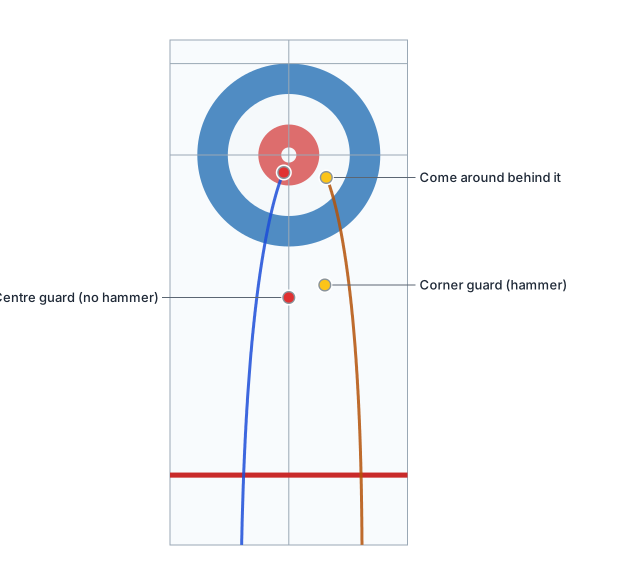
Centre guard: Beijing 2022 women's semifinal, 2nd end, Japan without the hammer Before the shotAfter the shot
▶ Corner guard: the same game, 3rd end. Japan, now with the hammer, places a guard in front of the house, off to the side Before the shotAfter the shot
5-2. Build up the house, or clear it?
The more stones there are around the house, the harder it is to predict what will happen.
The team that's ahead takes stones out to clear the house, and the team that's behind keeps stones in play to go for a big end.
5-3. Why are the last two stones so hard?
The skip's success rate (the last two stones) is 77%, lower than the lead's 86%. That's not because skips are worse players: they are more often left with the difficult shots.
On draws, leads make 84% and skips 75%. On takeouts, by contrast, skips are the highest at 84%.
5-4. What would you throw? (Real positions)
Once a position opens, switch to "Board" at the top of the screen to throw the next stone yourself (the shot described below). Open "Suggest" to see the win probability for that position and some candidate shots.
The "Try" button on the board re-throws the shot that produced the position you are looking at, so it takes you one stone back. Use "Board" here.
- PyeongChang 2018 women's bronze medal game, the last stone. Where should Great Britain's Eve Muirhead aim? Open this position
- 2025 Japan Olympic Trials, game 3: the last stone at 5-5. SC Karuizawa's stones are No. 1 to No. 3 in the house Open this position
- Milano Cortina 2026, Japan vs USA, 6th end at 3-3. Stone 13 of the end, thrown by the USA Open this position
- 2026 Japan Curling Championships women's final, 7th end. Hokkaido Bank has No. 1; stone 11 of the end, thrown by SC Karuizawa Open this position
- Milano Cortina 2026, Japan vs Sweden, 3rd end. Japan has No. 1 and No. 2; stone 15 of the end, thrown by Sweden Open this position
5-5. Practice puzzles
Each one opens on "Board", so you can throw and check your answer right away.
- ① Just before Yellow's last stone. How many points is Red scoring right now? Open this puzzle
- ② Stone 5 of the end, thrown by Red. Under the free guard zone rule, which stone may not be removed from play? Open this puzzle
- ③ Stone 2 of the end, thrown by Yellow. Try a draw that comes around the centre guard to the button Open this puzzle
Answers: ① Red scores 2. Two red stones are closer than Yellow's closest stone (the third red stone is outside it). ② The yellow stone in front of the house. Up to the fifth stone, you can't remove an opponent's stone in the free guard zone from play. The yellow stone in the house and your own red stones may be removed.
Glossary
| Term | Meaning |
|---|---|
| Back line | The line touching the back edge of the house |
| Blank end | An end in which neither team scores. The team with the hammer keeps it |
| Broom | The target marker the skip holds in the house (a brush) |
| Burned stone | A moving stone touched by a player's body or brush |
| Button | The circle at the centre of the house |
| Centre guard | A guard placed right in front of the house |
| Centre line | The line running lengthwise down the middle of the sheet |
| Clearing / peel | Knocking guards and other stones away hard |
| Concede | To admit defeat and end the game |
| Corner guard | A guard placed in front of the house, to the left or right |
| Curl | The stone bending in the direction of its spin |
| Double takeout | Knocking two stones out with one throw |
| Draw | A shot meant to stop in the house |
| End | One round of 16 stones (5 per team in mixed doubles). Four-player games have 10 ends |
| Extra end | An extra end played when the score is tied |
| Five-rock rule | The rule that an opponent's guards can't be removed from play until after the fifth stone (2018 onwards) |
| Force | When the team without the hammer holds the team with it to just one point |
| Free guard zone | The area where an opponent's stones can't be removed from play early in the end |
| Freeze | A shot that stops tight against an opponent's stone |
| Guard | A stone placed in front of the house to protect stones behind it |
| Hack | The foothold a player pushes off from when throwing |
| Half-time | The 5-minute break halfway through a game |
| Hammer | The last stone of the end; also the team that has it (throwing second) |
| Hit and roll | Knocking a stone out, then rolling your own stone to stay in a good spot |
| Hog line | The line by which the stone must be released. A stone that doesn't cross the far hog line is removed |
| Hog-to-hog time | The time the stone takes between the two hog lines. A measure of weight |
| House | The circles the teams score in |
| In-turn / out-turn | The direction of spin: turning the handle inwards / outwards, as seen by the thrower. It swaps with the throwing hand (for a right-hander, out-turn = counter-clockwise = the stone curls left; in-turn = clockwise = it curls right; for a left-hander it is the other way round). This app labels the two by the way the stone curls, which does not depend on the hand |
| Last stone draw (LSD) | Before the game, each team delivers two stones to the centre of the house, and the team with the smaller total distance chooses who throws first in the first end |
| Lead / second / third | The players who throw stones 1–2 / 3–4 / 5–6. The third is also called the vice |
| No-tick rule | The rule against moving a guard on the centre line aside early in the end (2022 onwards) |
| Number one (No. 1) | The stone closest to the centre of the house |
| Pebble | Tiny bumps made by sprinkling water on the ice and letting it freeze. They reduce friction between the stone and the ice |
| Promotion takeout | Pushing a stone in front into a stone behind to knock it out (runback) |
| Raise | Hitting a stone in front to push it farther in |
| Sheet | One strip of ice |
| Shooter | The stone that has just been thrown, as distinct from the stones already in play |
| Shot stone | The stone closest to the centre of the house; the same as number one (No. 1) |
| Skip | The team's leader. Usually throws the last two stones and gives instructions from the house |
| Slider | The slippery sole on the foot a player slides on when throwing |
| Steal | Scoring without the hammer |
| Sweeping | Brushing the ice with a broom. It makes the stone go farther and curl less |
| Takeout | Knocking an opponent's stone out |
| Tee line | The line across the centre of the house |
| Weight | How hard the stone is thrown. Often called as a zone (1–10) for draws, and in seconds for takeouts |
| Whoa | The call to stop sweeping |
| Yup | The call to sweep |
| Zone | A number from 1 to 10 for where a draw stops (in the Ferbey system, 7 is the button) |
Frequently asked questions
Why do they sweep the ice?
To reduce friction so the stone travels farther and curls less. It's the main way to adjust distance and direction after the throw
What are the players shouting?
Mostly sweeping calls. "Yup" means sweep and "Whoa" means stop. The numbers say how far the stone is expected to go (the zone)
Why is throwing last an advantage?
Because you see all the opponent's stones before settling the end with the last one
Why would a team finish an end with 0 points on purpose?
So the team with the hammer (the last stone) keeps it for the next end. Scoring 1 would pass the hammer to the opponent
What is a "steal"?
Scoring without the hammer. For the team with the hammer, it's a painful loss of points
How heavy is a stone?
17.24 to 19.96 kg, about 20 kg
How many players are on a team?
Four (lead, second, third and skip). Some events also register one alternate. In mixed doubles, teams have two players, one man and one woman
How long does a game take?
A 10-end four-player game often takes around two and a half to three hours, but this varies a lot with how the game goes
Why do some games end early?
Because a team that judges a comeback unlikely concedes
Is there a break during a game?
Yes. There is a 5-minute break halfway through (half-time), when players have a snack
What is the five-rock rule?
Up to the fifth stone of each end, you may not remove an opponent's stone in front of the house from play
Can I try throwing myself?
With CurlFlux you can, in just a browser, with physics on a sheet with the same dimensions as a real one. No sign-up needed
Sources
- Rules: World Curling, "The Rules of Curling and Rules of Competition", 1 September 2026 (R1–R19 and C5–C8)
- Success rates and win probabilities: our own counts from World Curling / CURLIT public records (Results Books and Shot by Shot), covering 22,384 four-player games and about 480,000 shots
- The draw zones (Ferbey system): the Silicon Valley Curling Club member handbook (Figure 2)
- Real positions: the CurlFlux library; the source of each game is listed in the game library
- "Mogumogu time" and "sodane": Japanese coverage of PyeongChang 2018 and the buzzword-of-the-year announcement (nicknames that spread in Japan, not rules)
Every position on this page opens in CurlFlux, ready to throw. No sign-up, nothing to install.
Open CurlFlux